The missing 500 million: Cosmic bombardment melted Earth's first crust
The heat of the Hadean may have come from impacts as well as the interior.
Signal weather
Rising
Momentum is building quickly, so this card is a good early entry point into the topic.
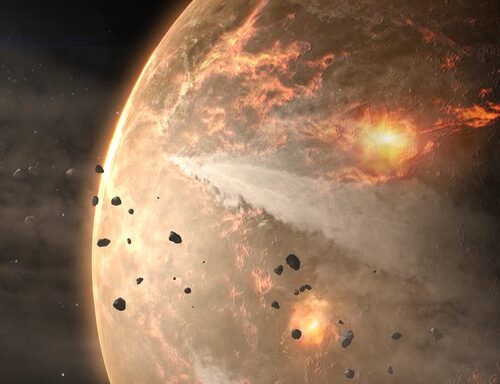
Earth is the only planet we know of with buoyant, silica-rich continents. But, despite decades of research, geologists still don't agree on how they formed. "The continents started appearing around about four billion years ago—that's the oldest continental rock we know about,” said Tim Johnson, a geologist at Curtin University in Perth, Australia. “The Earth is four and a half billion years old, so why they started appearing then is unknown, as is the mechanism to make that continental crust." Johnson and his colleagues are now arguing that the formation of continents on Earth was caused largely by an intense, sustained barrage of asteroid impacts that kept the early crust hot and thin enough to make buoyant continents possible. In short, the lands we live on are here because of ancient bombardment from space. Plates and plumes The problem with studying the formation of continents is that the geological evidence of this process is almost gone. The oldest known continental-type rocks crystallized around 4.03 billion years ago, right at the end of the Hadean eon (the earliest era in Earth’s history, spanning the first 500 million years of its existence). Rare basaltic rocks date back about 4.2 billion years, and a handful of the oldest zircon crystals push the record back to 4.4 billion years. Beyond that, there's hardly anything else. So, scientists looking into the origin of continents had to rely largely on educated guesses. “There are huge debates about what was going on in the early Earth, because the data is so scarce,” Johnson said. Read full article Comments
Stay on the signal
Follow The missing 500 million: Cosmic bombardment melted Earth's first crust
Follow this story beyond a single article: new follow-ups, adjacent sources, and the evolving storyline.
Story map
Understand this topic fast
A quick entry into the story: why it matters now, who is involved, and where to go next for context.
Why it matters now
Topic constellation
Open the live map for this story
See which entities, story threads, sources, and follow-up articles shape this story right now.
Click nodes to continue
Entity pages
Story timeline
Continue with this story
A short sequence of events and follow-up stories to understand the arc quickly.
How reliable this looks
Signal and trust for Ars Technica
This source works at a steady pace: 100% of recent stories land in the hot window, and 0% carry visible search signal.
Reliability
92
Freshness
100
Sources in storyline
2
Related articles
More stories that share tags, source, or category context.
The Czinger 21C might be the wildest car we drive all year
This hybrid V8 has organic-looking 3D-printed components and shatters lap records.
Signal weather
Momentum is building quickly, so this card is a good early entry point into the topic.
Why now
Fresh coverage with immediate momentum.
Show HN: Paint the Earth on a live, interactive globe (collaborative art.)
Comments
Signal weather
Momentum is building quickly, so this card is a good early entry point into the topic.
Why now
Fresh coverage with immediate momentum.
NASA launches robot to save Swift telescope falling to Earth
Comments
Signal weather
Momentum is building quickly, so this card is a good early entry point into the topic.
Why now
Fresh coverage with immediate momentum.
Chemical accidents rise as Trump administration proposes weakening safety rules
Chemicals from accidents that injured or killed people increased by nearly 50 percent in recent years.
Signal weather
Momentum is building quickly, so this card is a good early entry point into the topic.
Why now
Fresh coverage with immediate momentum.
More from Ars Technica
Fresh reporting and follow-up coverage from the same newsroom.
Bentley teases its first EV, the Torcal
The new model will be officially unveiled in late September.
Signal weather
Momentum is building quickly, so this card is a good early entry point into the topic.
Why now
Fresh coverage with immediate momentum.
The Czinger 21C might be the wildest car we drive all year
This hybrid V8 has organic-looking 3D-printed components and shatters lap records.
Signal weather
Momentum is building quickly, so this card is a good early entry point into the topic.
Why now
Fresh coverage with immediate momentum.
Chemical accidents rise as Trump administration proposes weakening safety rules
Chemicals from accidents that injured or killed people increased by nearly 50 percent in recent years.
Signal weather
Momentum is building quickly, so this card is a good early entry point into the topic.
Why now
Fresh coverage with immediate momentum.
Review: Supergirl is not the disaster its low box office suggests
It’s a pretty good movie, but it needed to be a great movie to thrive in an oversaturated superhero market.
Signal weather
Momentum is building quickly, so this card is a good early entry point into the topic.
Why now
Fresh coverage with immediate momentum.